- Phil~Italy Newsletter
- Posts
- Nature and Biodiversity in Italy
Nature and Biodiversity in Italy
The Mountains of Sicily

Bob Sorrentino for Phil~italy
January 27, 2026
Welcome Back (bentornati) to Phil~italy Cultural Exchanges Newsletter. We publish bi-weekly exploring the food, culture, music, art, architecture, natural beauty and history of our beloved Italy.
To stay updated on missed articles, please subscribe and visit our archive.
Soon to be on sale: Two new Phil~italy group Trips
July 2026 and August 2026, each 12 day all inclusive priced itinerary.
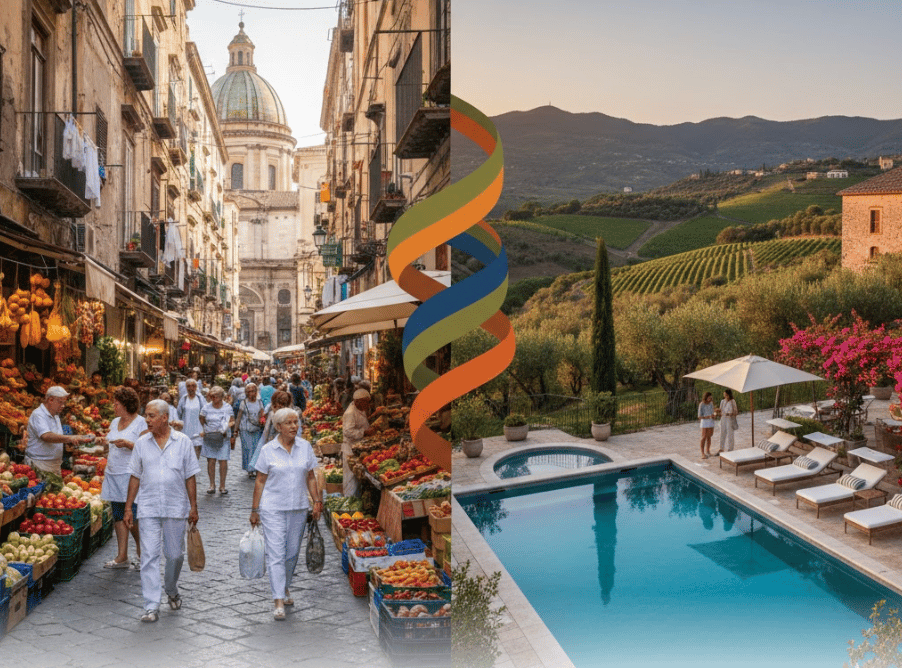
Experience a journey of contrasts in Central-Southern Italy, where the vibrant pulse of ancient cities meets the quiet, sun-drenched rhythms of the rustic interior. This is a land where you can wake up to the lively chaos of a Neapolitan market and fall asleep in a rural setting in the foothills of the Apennine Mountains. Rest each night in a resort-style hotel rather than hotel hopping. Enjoy easy access to a large swimming pool to cool off from the summer heat, preparing you for the next day of enticing La Dolce Vita excursions, or simply relax and stay put.
Look for details on these Phil~Italy Summer 2026 trips on our website www.philitaly.co and in the next newsletter issue in a couple of weeks
Sicily is often imagined as a sun-drenched island of beaches and baroque cities, but its true backbone is mountainous. From east to west, a series of ranges and highlands shape not only the island’s landscape but also its history, agriculture, and culture.
Along the northern coast runs what is often called the Sicilian Apennines, a chain of mountains that stretches from the Strait of Messina toward the island’s center. This northern spine is made up of three distinct groups. Closest to Messina rise the Peloritani Mountains—steep, jagged peaks that feel more like mainland Calabria than Sicily itself. Moving westward, the terrain softens into the Nebrodi Mountains, often described as the green heart of the island. Here, forests replace bare rock, lakes dot the highlands, and Sicily’s largest natural park preserves an unexpectedly Alpine atmosphere. Farther west still lie the Madonie Mountains near Cefalù, home to Sicily’s highest peaks after Mount Etna. Medieval villages cling to their slopes, and in winter, snow can even blanket the island’s only ski resort.
Dominating the eastern horizon is Mount Etna, not a mountain range but a colossal stratovolcano that defines the landscape around it. Rising higher than any peak in Italy south of the Alps, Etna is both destructive and generous. Its eruptions have reshaped the land for millennia, yet its mineral-rich soil has created one of Sicily’s most fertile regions. Vineyards, citrus groves, and orchards flourish on its slopes, forming a unique microclimate that has become world-famous for wine and produce.

In the southeast corner of the island, near Ragusa and Syracuse, the Hyblaean Mountains tell a different story. Rather than sharp peaks, they form a vast limestone plateau carved by deep, dramatic canyons known locally as cave. Rolling hills are divided by traditional white stone walls, and the landscape feels ancient and pastoral, shaped more by erosion than by volcanic fire.
Further inland, between Agrigento and Palermo, rise the rugged Sicani Mountains. This is one of Sicily’s most isolated regions, where small towns seem suspended in time. Among them is Palazzo Adriano and the striking Teatro di Andromeda, an open-air stone theater aligned with the stars. From here, the views stretch across some of the island’s most untouched and hauntingly beautiful terrain.

Together, these mountains reveal a Sicily far removed from postcard beaches—a land of forests and fire, plateaus and peaks, where geography has quietly guided centuries of human life. To understand Sicily, you don’t just look to the sea. You look upward, to the mountains that hold its deepest stories.
In Sicily’s mountains, you don’t just trace your roots—you walk among them.

Who Were The First Sicilians?

Archaeological evidence shows that people were living in Sicily as early as 10,000 BC, possibly arriving by sea from Western and Central Europe. Cave drawings at Addaura near Palermo (c. 8000 BC) and copper tools from 3000 BC reveal an island inhabited long before recorded history.
By the second millennium BC, three main peoples lived on the island: the Elymians, Sicani, and Siculi (Sicels)—from whom Sicily takes its name. Modern research suggests the Sicani were native to Sicily, while the Siculi arrived later (1200–1000 BC) from southern Italy and were related to early Italic peoples whose languages eventually led toward Latin.
The Elymians, centered in western Sicily, may have had eastern Mediterranean roots and show Phoenician and Assyrian influence. By 1100 BC, the Phoenicians founded settlements such as Palermo (Panormos) and Motya near Marsala, later controlled by Carthage.
These early peoples laid the foundation for Sicily’s rich cultural identity—an ancient blend of native traditions and Mediterranean influences that still shapes Sicilian heritage today.

“We highly recommend you dine in these very authentic Italian and Sicilian Restaurants”
 |  |  |
|

Are you planning a trip to Italy in the next two years? |
Reply